Use a proforma invoice as a pre-shipment quote and a commercial invoice as the final customs and accounting document. The rule of thumb: issue a proforma to arrange import permits, letters of credit, or buyer sign-off before goods move, then issue the commercial invoice with the shipment itself, since that's the document customs and your accounting team treat as binding.
TL;DR:
- A proforma invoice supports import permits and financial arrangements, but the commercial invoice is necessary for customs clearance and binding accounting entries.
- Correctly including HS codes, accurate country of origin, and signed declarations on the commercial invoice is essential to avoid delays or customs holds.
- Discrepancies between proforma and commercial invoice values or missing HS codes are the most common causes of shipment delays in petroleum exports.
- Customs sometimes accept a proforma temporarily, but often require a bond and a timely submission of the commercial invoice for final clearance.
- Pre-shipment invoice review helps identify and fix errors like mismatched weights, vague descriptions, and missing technical details before customs questions arise.
Table of Contents
- Proforma vs Commercial Invoice: What Sets Them Apart From The Start
- What Is A Commercial Invoice And Why Does Customs Rely On It?
- Proforma Vs Commercial Invoice: A Side-By-Side Comparison
- Getting The Commercial Invoice Fields Right
- A Practitioner Checklist For Avoiding Customs Holds
- Why Documentation Accuracy Is An Operational Lever, Not Paperwork
- Get Your Invoice Documentation Ready Before It Costs You A Shipment
- Sources
- FAQ
Proforma vs Commercial Invoice: What Sets Them Apart From The Start
A proforma invoice is a preliminary bill of sale, not a demand for payment. It quotes prices and terms before a sale is finalized, which is why it never lands in accounts receivable. Buyers and regulators use it to plan, not to pay.
Where does it actually get used? More often than you'd expect for a document with no legal weight:
- Applying for an import license or permit before goods are ready to ship
- Supporting a letter of credit application at the buyer's bank
- Giving a buyer a firm enough number to secure internal budget approval
- Accompanying samples or gifts that cross a border with no commercial sale attached
- Satisfying currency transfer controls in countries that require documentation before funds move
A proforma worth using includes seller and buyer information, the quoted items and their estimated values, the Incoterm governing the deal, a validity date (prices change, and buyers need to know how long the quote holds), and an estimated shipping date. Skip any of these, and the document loses most of its practical value, even though it still carries no accounting weight either way.
What Is A Commercial Invoice And Why Does Customs Rely On It?
The commercial invoice is the final bill of sale. Once it's issued, it becomes a real accounting entry, recorded in accounts receivable for the seller and accounts payable for the buyer. There's no ambiguity left in the transaction at this point: goods have shipped, a price is fixed, and a legal record now exists.
Customs authorities lean on this document to calculate what a shipment actually owes in duties and taxes. That means the declared value, the HS code for each item, the country of origin, and the agreed Incoterm all directly affect the assessment a broker files.
A commercial invoice built for smooth clearance typically includes:
- Invoice number and issue date
- HS codes for every line item, not just the shipment as a whole
- Country of origin
- Exact quantities and unit values, plus the total in a clearly stated currency
- Seller and importer tax identification numbers
- A signed declaration attesting the invoice is accurate
Missing HS codes are one of the most common triggers for shipment delays, a detail that surprises exporters who assume a general product description is close enough.
Proforma Vs Commercial Invoice: A Side-By-Side Comparison
The two documents look similar on the page but function completely differently once goods are in transit.
- When issued. The proforma comes before the sale is confirmed, often weeks or months ahead of shipment. The commercial invoice is issued at or immediately before shipment, once the deal is final.
- Legal and accounting status. The proforma is non-binding and stays off the books. The commercial invoice is a binding record entered into accounts receivable and payable.
- Typical use case. Proforma invoices support permits, quotations, and letters of credit. Commercial invoices support customs clearance and payment collection.
- Required fields. Both list items and values, but only the commercial invoice must carry HS codes, exact country of origin, and a signed declaration for customs to act on it.
- Customs acceptance. Some customs authorities will accept a proforma temporarily for an initial assessment, especially when a shipment moves faster than paperwork. But that acceptance usually comes with strings: a bond posted against potential duties, and a firm deadline to submit the commercial invoice afterward.
A sample shipment with no commercial value might travel on a proforma alone. A return merchandise authorization often does too. But a standard sale, the kind most petroleum-sector exporters handle, needs a commercial invoice riding with the goods. Treating a proforma as a substitute here is the single fastest way to create a customs hold, because brokers can't finalize duty calculations off an estimate.
Getting The Commercial Invoice Fields Right
Four fields cause more customs friction than everything else on the form combined.
HS codes and product descriptions. Customs uses the Harmonized System code to classify goods and apply the correct duty rate. A vague description like "industrial equipment" forces a customs officer to guess, and guessing means a hold while someone requests clarification.
Country of origin. This determines duty rates and whether a shipment qualifies for preferential treatment under a trade agreement. Get it wrong and you either overpay duties or trigger an audit when the discrepancy surfaces later.
Incoterms. The agreed term (FOB, CIF, DAP, and so on) changes who's responsible for freight, insurance, and duties, which in turn changes the declared value customs actually assesses.
Tax IDs, currency, and signatures. Every invoice needs clear seller and importer tax identification, one stated currency (not a mix of quoted and converted figures), and a signed declaration. The invoice also has to match the packing list line for line.
Pro Tip: Before a shipment leaves the dock, lay the proforma, the commercial invoice, and the packing list side by side. If the weights, quantities, or values don't match across all three, fix it before the truck loads, not after customs flags it.
A Practitioner Checklist For Avoiding Customs Holds
Petroleum-sector shipments carry their own documentation risk, given the technical product descriptions and certificates involved. A short pre-shipment review catches most of what causes delays:
- Reconcile every value on the proforma against the final commercial invoice
- Confirm HS codes match the actual product, not a generic category
- Attach certificates of origin where preferential duty treatment applies
- Check that the packing list quantities match the invoice exactly
- Confirm the Incoterm and both parties' tax IDs are present and correct
The most frequent mistakes we see are inconsistent weights between documents, missing HS codes, descriptions vague enough to invite a customs query, and exporters who never convert a proforma into a commercial invoice before a destination country's deadline passes.
Pro Tip: If your buyer's country enforces a strict window to submit a commercial invoice after a proforma-based clearance, calendar that deadline the day the proforma goes out, not the day the shipment departs.
A document review at this stage, checking templates, correcting fields, confirming readiness, catches the errors before they become a broker's problem or a customs officer's question.
Why Documentation Accuracy Is An Operational Lever, Not Paperwork
Accurate commercial invoices shorten customs clearance and cut down on the audits and penalties that follow inconsistent paperwork. That's not a compliance nicety; it's a direct line to whether cargo moves on schedule.
Proforma invoices, used correctly, prevent financing and licensing delays without ever muddying your accounts. The two documents do different jobs, and treating them as interchangeable is where most delays start. For petroleum-sector exporters and importers, where certificates of origin and precise technical descriptions carry extra scrutiny, documentation discipline is what keeps shipments moving.
— Blastoff
Get Your Invoice Documentation Ready Before It Costs You A Shipment
Petroleum trade documentation reviews performed before shipment can catch mismatched values, missing HS codes, and proforma-to-commercial conversion gaps before they cause customs holds.

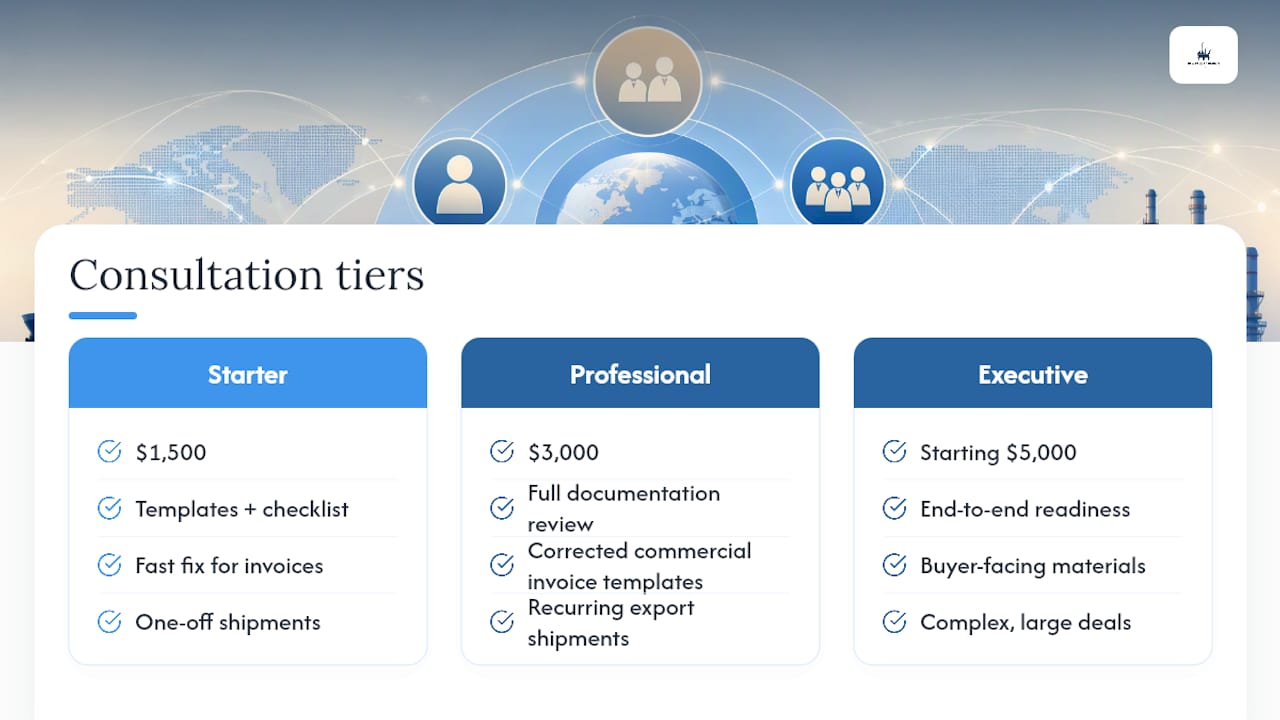
If you just need a fast fix, the Starter Consultation at $1,500 gives you templates and a checklist built to correct invoice issues quickly. Teams with recurring export shipments tend to need more depth: the Professional Consultation at $3,000 includes a full documentation review and corrected commercial invoice templates matched to your actual product lines. For complex, buyer-facing transactions, the Executive Consultation, starting at $5,000, covers end-to-end readiness support, including the buyer-facing materials that accompany larger deals.
Whichever level fits your operation, the next step is the same: get your documentation reviewed before it ships, not after customs sends it back. Visit the Blastoffofarming store to book the consultation that matches where your paperwork stands today.
Sources
For primary guidance, see trade.gov's pro forma invoice explainer, QuickBooks' commercial invoice template, and Wise's proforma vs commercial invoice comparison.
- Trade
- Commercial invoice template - QuickBooks
- Proforma invoice - Wikipedia
- Free commercial invoice template - FreeBillKit
FAQ
Do I need a commercial or proforma invoice with FedEx?
Most carriers, including FedEx, require a commercial invoice for dutiable shipments crossing international borders. A proforma invoice only works for non-sale shipments like samples or gifts with no commercial value attached.
What is the difference between a proforma invoice and a regular invoice?
A proforma invoice is a non-binding preliminary quote issued before a sale is confirmed, while a regular (commercial) invoice is the final, legally binding bill of sale recorded in accounting once the transaction is complete.
Will customs accept a proforma invoice?
Some customs authorities accept a proforma temporarily for initial assessment, but they typically require a bond and a commercial invoice submitted within a set deadline afterward.
What are the most common mistakes with proforma invoices?
The biggest ones are recording a proforma as a final sale in accounting, letting its values drift from the eventual commercial invoice, and missing the destination country's deadline to submit the commercial invoice after clearance. Blastoffofarming's document reviews catch these mismatches before shipment.