Laycan is the window in a charterparty during which a chartered vessel must arrive at the load port and tender a valid Notice of Readiness. The term is short for "laydays and cancelling," and it fixes two dates: the earliest a vessel can begin loading and the latest it can arrive before the charterer gains the right to walk away. Miss the second date, and the fixture is at risk.
TL;DR:
- The cancellation date in laycan determines the latest time a vessel must tender a valid notice of readiness to avoid contract cancellation.
- A vessel arriving before the laydays start generally cannot begin laytime until the specified opening date, requiring precise NOR timing.
- Market conditions influence whether charterers accept late vessels or cancel, with strict schedules more common in tight markets.
- Disputes often stem from unclear NOR validity criteria or poor communication, making early notification and accurate port recordkeeping crucial.
- Narrower laycan windows are achievable through firm notice protocols, but require diligent tracking of NOR tendering and port arrival times to prevent disputes.
Table of Contents
- What Is Laycan? Definition and Where It Sits in the Contract
- How Do Laydays and the Cancelling Date Work?
- What Happens Operationally Once NOR Is Tendered?
- What Happens If a Vessel Misses the Laycan?
- Laycan Examples and Common Clause Wording
- How Owners and Charterers Manage Laycan Risk
- Why Laycan Precision Matters for Procurement Teams
- How Blastoffofarming Helps You Get Laycan Documentation Right
- Sources
- FAQ
What Is Laycan? Definition and Where It Sits in the Contract
The laycan definition covers two linked ideas that only make sense together: laydays, the earliest date a vessel may tender NOR and begin counting laytime, and the cancelling date, the last date it can arrive before the charterer may cancel the fixture. Charterparties almost always state these as a clause near the top of the voyage terms, right alongside load port, discharge port, and freight rate, because the whole schedule for the voyage hangs on it.
Both dates exist for a reason. Owners need a floor so they are not penalized for arriving too early and disrupting the charterer's cargo readiness or port slot. Charterers need a ceiling so they are not left holding cargo, storage costs, or a missed sales contract while waiting on a vessel that never shows.
Typical clause wording looks something like this, paraphrased from standard forms:
- "Laycan: 10 April to 15 April, both dates inclusive."
- "Vessel to tender NOR not before 0001 hours on the first day of laycan."
- "Should the vessel fail to give NOR by 2359 hours on the cancelling date, charterers have the option to cancel this charterparty."
That last line is the one that gets tested in practice. Laycan is an abbreviation of "laydays and cancelling", and it defines exactly the window in which a vessel must arrive and give valid notice, with late arrival opening the door to cancellation rather than forcing it automatically.
How Do Laydays and the Cancelling Date Work?
Reading a laycan notation correctly comes down to three things: the date range, the readiness standard, and the time convention attached to each end.
- Laydays commence marks the earliest point laytime can start running. A vessel arriving before this date typically has to wait, since NOR tendered too early is not valid for starting the laytime clock.
- Cancelling date is the deadline. Physical arrival alone does not satisfy it. The vessel must tender a valid NOR by that date, not just be sitting at anchorage nearby.
- Notation shorthand commonly appears as something like "laycan 10/15 April," meaning laydays commence April 10 and the cancelling date is April 15.
Time conventions matter more than most people expect. A clause might specify laydays cannot commence "before 0001 hours" on the first date, while NOR must be tendered "not later than 2359 hours" local time on the cancelling date. Contract dictionaries confirm that laycan clauses tie the cancelling date to a valid NOR rather than to mere arrival, which is exactly why agents track NOR timestamps as closely as they track port entry.
What Happens Operationally Once NOR Is Tendered?
Once a valid NOR is tendered inside the laycan window, laytime starts running according to the charterparty's own laytime clause, which is often a fixed number of hours after tendering (commonly six or twelve, depending on the form used). From that point, the commercial clock that determines demurrage and despatch is live.
- Laytime is the allowed time for loading or discharging; running past it typically triggers demurrage payments to the owner.
- Finishing within laytime, on some forms, earns the charterer despatch money, essentially a rebate for speed.
- Cancelling is an option the charterer holds, not an automatic termination of the contract. If the vessel misses the cancelling date, the charterer must actively elect to cancel; silence, or continued cooperation with loading arrangements, can be read as a waiver of that right.
- Port authority arrival records and agent-logged NOR timestamps are the operational evidence both sides rely on if a dispute over timing arises later.
Laycan works as a coordination and risk-allocation device between the two parties, since the spread between dates reflects genuine commercial and operational uncertainty on both the shipping and cargo side. Owners rarely want a narrow window because voyage timing is never perfectly predictable, and charterers rarely want a wide one because it complicates their own cargo and berth planning.
Pro Tip: Always confirm whether your charterparty defines NOR validity by "arrival at the port" or "arrival at the berth." That single distinction has decided more laycan disputes than almost any other clause wording.
What Happens If a Vessel Misses the Laycan?
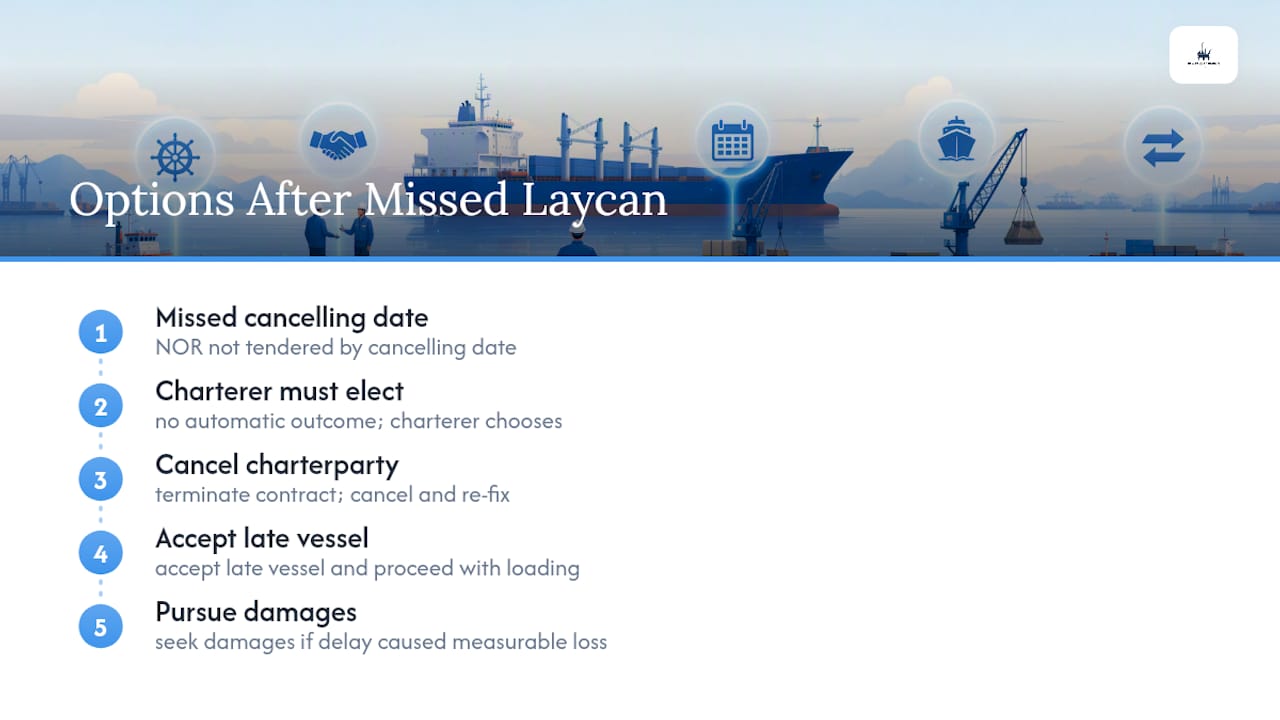
When a vessel fails to tender valid NOR by the cancelling date, the charterer typically has three real options: cancel the charterparty outright, accept the late vessel and proceed with loading, or in rarer cases pursue damages if the delay caused measurable loss. None of these happens automatically. The charterer has to elect one.
Legal commentary on The Front Commander frames laycan clauses as marking both the earliest day an owner can expect the charterer to be ready and the latest day the vessel can arrive without risking cancellation, a framing that has shaped how tribunals read these clauses in later disputes.
Market conditions usually decide what happens next. In a soft freight market, charterers frequently accept a late vessel rather than cancel and re-fix, since finding a replacement may cost more time and money than the delay itself. In a tight market, cancellation and re-fixture at a better rate can be the more attractive path.
Laycan Examples and Common Clause Wording
A few short examples make the mechanics concrete:
- "Laycan 1/5 May" means laydays commence May 1 and the cancelling date is May 5, a tight five-day spread typical of tanker fixtures with firm cargo commitments.
- "Laycan 10/20 June" gives a ten-day spread, more common in dry bulk trades where port congestion and cargo assembly are harder to predict.
- "NOR tendered 0800 hours 3 May, laycan 1/5 May" shows a valid tender inside the window, meaning laytime begins running per the charterparty's laytime clause.
Sector matters here. Tanker and crude oil fixtures often run tighter laycan spreads, sometimes as narrow as 48 hours, reflecting the operational realities of cargo laycan in the tanker market, while bulk cargo fixtures tend to allow wider windows to absorb port and weather variability.
How Owners and Charterers Manage Laycan Risk
Most disputes over laycan come down to poor communication, not poor drafting. Managing it well is mostly a matter of discipline.
- Narrow the laycan by definite notice. Many charterparties allow owners to give a narrower, firmer window (say, three days) a set number of days before the original spread begins, giving the charterer better planning certainty.
- Track NOR tendering against port records. Agents should log arrival time, NOR tender time, and any acceptance or rejection by the charterer's representative, since port authority timestamps are the standard evidence in any later dispute.
- Communicate early if delay looks likely. Owners who flag a probable late arrival well before the cancelling date give charterers time to plan around it, rather than forcing a last-minute cancellation decision.
Pro Tip: Build a standing checklist with your agent for every fixture: expected arrival, laycan window, NOR tender time, and port acceptance stamp. Missing paperwork causes more laycan disputes than missing ships.
Why Laycan Precision Matters for Procurement Teams
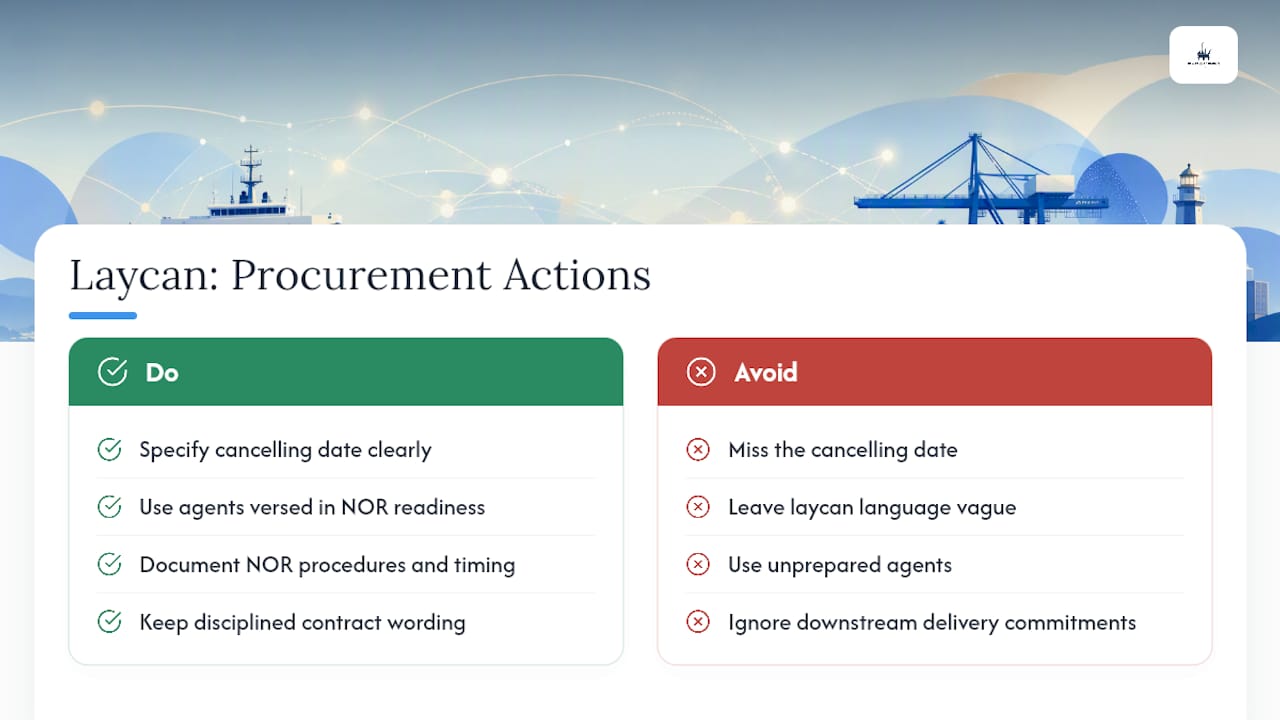
Laycan is not just a shipping technicality. For petroleum buyers and suppliers, a missed cancelling date can unwind a cargo deal, a storage arrangement, or a buyer's own delivery commitments downstream. Clear contract language and agents who understand NOR readiness reduce disputes before they start, and that discipline is part of what makes a counterparty look serious in procurement negotiations.
How Blastoffofarming Helps You Get Laycan Documentation Right
Petroleum suppliers and buyers who get burned on laycan disputes usually trace the problem back to weak documentation, not bad luck. Consulting specialists review charter paperwork, NOR readiness processes, and buyer-facing materials before you go to market, so gaps get caught in preparation rather than in a dispute.

The Starter Consultation covers a quick documentation review and readiness check, useful if you need a fast second opinion on charter wording or NOR procedures before a fixture closes. The Professional Consultation goes deeper into operational coordination support, helping suppliers and buyers align vendor registration and contract language with how deals actually move in the market. For buyers and suppliers preparing a broader push into new markets, the Executive Consultation covers strategic procurement readiness and buyer-facing positioning at a higher level. Check the Blastoffofarming store for full details on each package and book the one that matches where you are in your outreach.
Sources
For readers who want to go straight to the primary explanations behind this article's claims:
- What Is Laycan? Definition + 5 Ways to Stay Ahead - Base
- Laycan in Charterparty: Laydays, Cancelling Date, Right to Cancel
- LAYCAN: Key Concepts And Significance In Charterparties
FAQ
What happens if a ship misses the laycan?
The charterer gains the option to cancel the charterparty, but cancellation is not automatic. The charterer can also choose to accept the late vessel or, in some cases, pursue damages if the delay caused measurable loss.
What is laycan in oil and gas shipping?
In oil and gas trades, laycan works the same way it does in general shipping: a fixed date window for a tanker to arrive and tender NOR, often with a narrower spread than bulk cargo fixtures because of tighter delivery schedules.
What is the difference between laycan and laytime?
Laycan is the arrival window that determines when NOR can be validly tendered and when cancellation rights kick in. Laytime is the separate, subsequent period allowed for loading or discharging once that NOR has been accepted.
Where can I find laycan examples?
Common notations look like "laycan 10/15 April," meaning laydays commence April 10 and the cancelling date is April 15. Charterparties and shipping glossaries typically show this format alongside clause language specifying NOR timing and cancellation rights.